
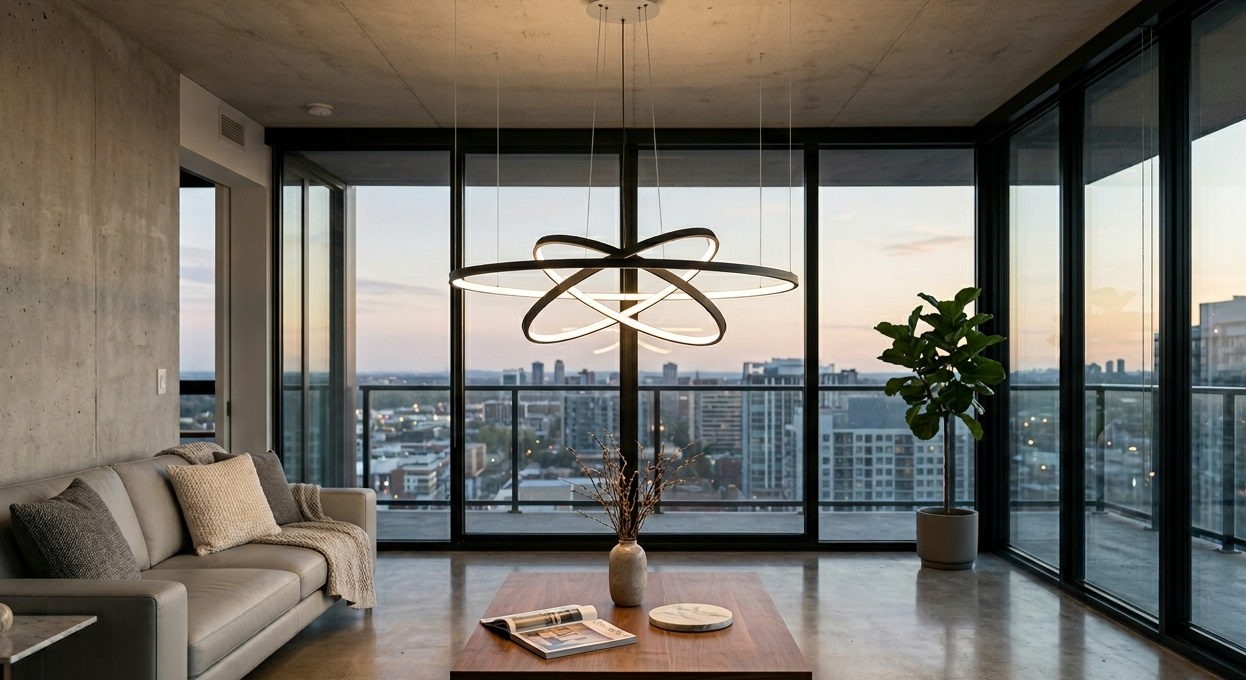



how to choose a chandelier for a living room, it crucial to understand that lighting is the invisible architecture of a home. You can invest in premium Italian marble, bespoke low-profile furniture, and curated modern art, but without the correct luminous flux and scale, the entire design language collapses. A chandelier is not merely a fixture to dispel darkness; it is the visual anchor, the crown jewel, and the literal centerpiece of your living room’s design matrix.
Lighting is the invisible architecture of a home. You can invest in premium Italian marble, bespoke low-profile furniture, and curated modern art, but without the correct luminous flux and scale, the entire design language collapses. A chandelier is not merely a fixture to dispel darkness; it is the visual anchor, the crown jewel, and the literal centerpiece of your living room’s design matrix.
When homeowners step into a lighting showroom or browse premium digital catalogs, they are often overwhelmed by the sheer volume of choices. From cascading K9 crystal configurations to ultra-modern minimalist interlocking geometric LED rings, the options are endless. However, choosing the wrong size, incorrect color temperature, or an incompatible design aesthetic can make a luxury space feel cramped, disjointed, or visually chaotic.
This comprehensive, highly technical, and architecturally grounded guide is engineered to eliminate that guesswork. We will break down the exact mathematical formulas, interior design principles, material sciences, and installation protocols required to master the art of selecting the perfect chandelier. Whether you are an interior designer sourcing for a high-end penthouse or a homeowner looking to elevate a contemporary apartment hall, this masterclass provides the definitive blueprint.

1. The Mathematics of Lighting Scale : Sizing Your Chandelier Perfectly
The most common mistake in residential interior(How to Choose a Chandelier for a Living Room) design is miscalculating the physical scale of the ceiling fixture. An oversized chandelier suffocates a room, making the ceiling feel low and oppressive. Conversely, an undersized chandelier gets swallowed by the surrounding architecture, looking like a design afterthought. To achieve visual harmony, professional interior architects rely on three strict mathematical metrics: Diameter, Height, and Clearance.
The Chandelier Diameter Formula (The Imperial to Metric Translation Trick)
To determine the ideal diameter of your living room chandelier using standard room dimensions, professionals use a classic design shorthand that converts feet into inches, which can then be adapted to any standard layout.
$$\text{Ideal Chandelier Diameter (in Inches)} = \text{Room Length (in Feet)} + \text{Room Width (in Feet)}$$
For instance, let us calculate the requirement for a standard luxury living room layout:
- Room Length: 14 feet
- Room Width: 10 feet
- Mathematical Equation: $14 + 10 = 24$
- Result: The ideal chandelier diameter for this specific room footprint is 24 inches.
If you prefer working entirely in the metric system (meters and centimeters) for a contemporary apartment hall, use this precise formula:
$$\text{Chandelier Diameter (in cm)} = (\text{Room Length in meters} + \text{Room Width in meters}) \times 8.33$$
Let us apply this to a modern open-concept hall measuring $4.2\text{ meters} \times 3.6\text{ meters}$:
- Sum of dimensions: $4.2 + 3.6 = 7.8\text{ meters}$
- Calculation: $7.8 \times 8.33 = 64.97\text{ cm}$
- Result: You should target a fixture with a diameter of approximately 65 centimeters.
The Vertical Height Calculation – How to Choose a Chandelier for a Living Room
A horizontal footprint calculation is only half the battle. You must also calculate the vertical volume of the fixture to ensure it matches the vertical scale of your walls. The industry standard dictates that a chandelier should feature 2.5 inches to 3 inches of vertical height for every 1 foot of total room height.
$$\text{Minimum Fixture Height (Inches)} = \text{Ceiling Height (Feet)} \times 2.5$$
$$\text{Maximum Fixture Height (Inches)} = \text{Ceiling Height (Feet)} \times 3.0$$
Let us evaluate three distinct ceiling architectures:
| Ceiling Type | Total Room Height (Feet) | Ideal Fixture Vertical Height Range (Inches) |
| Standard Apartment | 9 Feet | 22.5″ to 27″ |
| Premium High-Ceiling | 11 Feet | 27.5″ to 33″ |
| Luxury Duplex / Double-Height | 18 Feet | 45″ to 54″ |
The Clearance Protocol: Avoiding Structural Interference
The spatial relationship between the bottom of the chandelier and the surfaces below it is non-negotiable for safety, structural integrity, and sightlines.
- Open Walkway Clearance: If the chandelier hangs over an open living room floor where people walk, the lowest point of the fixture must sit at least 7 feet (84 inches / 213 cm) above the finished floor. This provides ample clearance for tall individuals and prevents visual obstruction across the room.
- Central Coffee Table Alignment: If the chandelier is strictly anchored directly over a central low-profile coffee table, you can lower the fixture slightly to create an intimate focal point. In this specific scenario, maintain a minimum distance of 60 inches to 66 inches (152 cm to 167 cm) from the top of the coffee table surface to the bottom of the lighting fixture. This ensures the light pool encapsulates the seating area perfectly without causing glare or physical obstruction when leaning forward.
2. Structural Integrity & Installation Engineering: Weight, Boxes, and Support
Before buying a heavy multi-tier luxury fixture, you must address the physical reality of its weight. Residential ceilings are constructed with gypsum board or plasterboard supported by wood or metal framing. Standard plastic or lightweight metal electrical boxes are engineered to support fixtures weighing up to 50 pounds (approx. 22.6 kg).
If your chosen chandelier exceeds this weight threshold—which is common with heavy solid-core brass frameworks or extensive K9 lead crystal arrays—standard installation procedures will fail, creating a severe structural hazard.
[Ceiling Concrete Slab / Main Framing Joists] │ ┌─────────┴─────────┐ │ Heavy-Duty Fan/ │ <── Secured via concrete anchor bolts │ Chandelier Box │ or heavy-duty timber lag screws └─────────┬─────────┘ │ ┌─────────┴─────────┐ │ Safety Support │ <── Dedicated aircraft grade steel cable │ Aircraft Cable │ running directly into the structural frame └─────────┬─────────┘ │ [Chandelier Mounting Bracket & Canopy]
The Heavy-Duty Junction Box Requirements – How to Choose a Chandelier for a Living Room
- UL Listed Chandelier Boxes: For fixtures weighing between 50 and 150 pounds, you must install a specialty commercial-grade metal junction box explicitly marked and UL Listed for “Acceptable for Chandelier Support.” These are anchored to structural ceiling joists using heavy-duty threaded steel lag bolts.
- Independent Structural Support: For master-scale luxury chandeliers exceeding 150 pounds, the electrical box cannot act as the primary weight bearer. Instead, an independent structural support mechanism—such as a steel threaded rod system connected directly to the building’s concrete slab or primary steel roof beams—must be installed by a certified structural engineer.
The Safety Wire Protocol
Every premium high-end modern chandelier should feature an independent safety aircraft cable. This is a high-tensile braided steel wire running parallel to the main decorative chain or rod, anchored directly to the architectural ceiling frame. In the highly unlikely event that the primary mounting bracket or threaded stem suffers mechanical failure, this safety cable catches the entire weight of the fixture, preventing catastrophic structural failure or personal injury.
3. Luminous Flux and Color Temperature: The Science of Living Room Ambience – How to Choose a Chandelier for a Living Room
A beautifully scaled chandelier that emits harsh, clinical blue light or dull, dingy yellow light will ruin your entire living room interior design. To curate a luxurious atmosphere, we must examine the technical parameters of the light source itself: Lumens, Kelvins, and the Color Rendering Index (CRI).
The Living Room Lumen Formula
A common misconception is that wattage determines brightness. Wattage measures electrical energy consumption; Lumens ($\text{lm}$) measure the actual output of visible light. To determine exactly how much light output your living room requires, we use the “Foot-Candle” method. A (How to Choose a Chandelier for a Living Room) standard, multi-functional living room requires roughly 10 to 20 foot-candles of ambient light intensity.
$$\text{Total Required Lumens} = \text{Area of Room in Square Feet} \times \text{Required Foot-Candles}$$
Let us compute the exact requirements for a standard premium living space:
- Room Area: 15 feet by 20 feet = 300 square feet.
- Minimum Target (10 Foot-Candles): $300 \times 10 = 3,000\text{ lm}$
- Maximum Target (20 Foot-Candles): $300 \times 20 = 6,000\text{ lm}$
Therefore, your total ambient light grid for this living room should supply between 3,000 to 6,000 lumens.
Crucial Architecture Rule: Do not expect your chandelier to provide all these lumens single-handedly! A luxury living room should distribute this output across a layered light plan: 50% from the central chandelier, 30% from recessed architectural downlights (COBs), and 20% from functional accent pieces like modern wall lamps or minimalist floor lamps.
Deciphering the Kelvin Scale (Color Temperature)
The color temperature of your light bulbs or integrated LED modules dictates the psychological mood of the space. It is measured on the Kelvin ($\text{K}$) scale:
[2200K - 2700K] ────────── [3000K - 4000K] ────────── [5000K - 6500K] Ultra-Warm Amber Soft Neutral White Clinical Blue/Daylight(Too Dim/Traditional) (Perfect For Luxury) (Harsh/Industrial)
- 2200K – 2700K (Warm Amber): Creates an ultra-cozy, historical, candlelight-like glow. While stunning for traditional crystal chandeliers or rustic design aesthetics, it can skew paint colors too yellow and lacks the clarity required for modern, crisp spaces.
- 3000K (Soft White): The exact sweet spot for luxury residential interiors. It balances warm, welcoming comfort with a crisp, clean output that prevents fabrics, paints, and wood tones from appearing muddy.
- 4000K (Neutral White / Cool White): Excellent for modern minimalist spaces featuring raw concrete, industrial glass, and polished steel finishes. However, if your living room has natural walnut woods or warm gold metals, 4000K can feel slightly clinical if not dimmed properly.
- 5000K – 6500K (Daylight / Cool Blue): Avoid this entirely for living rooms. It mimics hospital or commercial office environments and destroys any sense of home luxury.
The Color Rendering Index (CRI) Standard
When choosing an integrated LED chandelier or premium LED bulbs, always check the CRI rating. CRI measures how accurately (How to Choose a Chandelier for a Living Room) a light source reveals the true colors of objects compared to natural sunlight.
- Standard Bulbs: Feature a CRI of around 80. They can make rich fabrics and deep wood grains look slightly washed out or gray.
- Premium Residential LEDs: Require a CRI of 90 or higher ($\text{Ra} \ge 90$). High-CRI lighting ensures your custom sofas, high-end wood paneling, and interior paint hues appear extraordinarily vibrant, rich, and true to life.
4. Material Selection and Finish Chemistry: Matching Your Interior Matrix
The physical material and finish of your chandelier act as its tactile signature. A mismatch between the metal chemistry of your chandelier and the existing hardware in your living room can create visual discord. Understanding the physical and aesthetic characteristics of materials is critical to making an informed investment.
Read Also : The Ultimate Guide to Minimalist LED Wall Sconces for Living Rooms (2026 Trends)

Solid Brass vs. Anodized Aluminum vs. Electroplated Steel
- Solid Brass: The gold standard of luxury lighting (How to Choose a Chandelier for a Living Room) manufacture. Brass is non-ferrous, meaning it will never rust or degrade over time. It can be finished into a brilliant polished sheen, a muted brushed texture, or chemically oxidized into an antique oil-rubbed bronze appearance. It carries substantial weight and a highly premium feel.
- Anodized Aluminum: The preferred substrate for high-end modern minimalist linear or ring-style chandeliers. Aluminum is incredibly lightweight, allowing for massive structural profiles without risking ceiling collapse. The anodization process alters the metal surface at a molecular level, creating a flawless matte finish (in deep blacks, space grays, or champagne golds) that is completely scratch-resistant and immune to fading.
- Electroplated Low-Carbon Steel: A common material for mid-range and commercial designer chandeliers. Steel provides excellent structural rigidity. A micro-layer of premium metal (such as chrome, nickel, or rose gold) is chemically bonded via electroplating. While beautiful, it must be kept free of moisture to avoid eventual oxidation.
The Crystal Spectrum: K9 vs. Lead Crystal vs. Standard Glass
If your aesthetic leans toward a luxury focal point, you will likely choose a crystal configuration. However, not all crystals are created equal:
| Crystal Type | Chemical Composition | Light Refraction Index | Aesthetic Character | Cost Tier |
| Standard Glass | Basic Silica-Lime | Low | Dull, visible air bubbles, green tint at edges | Budget / Low-End |
| K9 Optical Crystal | Borosilicate Glass Substrate | High ($\approx 1.52$) | Extremely sharp facets, high clarity, lightweight, modern look | Premium / High-Value |
| Full Lead Crystal | Up to 24% to 32% Lead Oxide | Maximum ($\approx 1.56+$) | Razor-sharp diamond-like rainbow prism refraction, heavy weight | Ultra-Luxury / Heirloom |
5. Architectural Style Mapping : Pairing the Fixture to the Space
Every living room adheres to a specific architectural (How to Choose a Chandelier for a Living Room) or interior design style guide. Your chandelier should either harmonize directly with that style or serve as a calculated juxtaposition (a modern piece in a classic room, or vice versa). Let us explore the dominant design languages of 2026 and how to choose a chandelier that complements them perfectly.
Modern Minimalist & Contemporary Luxury
- Design Traits: Clean geometric planes, concealed storage, neutral palettes, raw concrete, large-format glass tile, polished steel, and low-profile furniture systems.
- The Perfect Chandelier: Minimalist interlocking LED ring chandeliers or architectural linear suspension configurations. Look for fixtures featuring slim aluminum profiles, hidden wiring channels, and frosted silicone diffusers that emit an unbroken beam of soft white light.
Transitional & Modern Classic – How to Choose a Chandelier for a Living Room
- Design Traits: A beautiful marriage of historical warmth and clean modern silhouettes. Think classic white crown molding and wall paneling paired with clean, contemporary tailored sofas.
- The Perfect Chandelier: A drum chandelier or an updated Sputnik configuration featuring frosted glass globes mounted on clean, geometric brushed brass or matte black iron arms. This provides a traditional nod to symmetry while eliminating over-the-top historical ornamentation.
Eclectic Luxury & Maximaist Glamour
- Design Traits: Bold jewel tones, rich velvet fabrics, geometric wallpaper accents, contrasting patterns, and highly curated art collections.
- The Perfect Chandelier: An oversized, cascading multi-tier K9 crystal chandelier or an avant-garde asymmetrical hand-blown glass sculpture. In a maximalist space, the chandelier should demand complete attention, acting as a dramatic piece of fine art.

7. Smart Controls, Integration, and Advanced Dimming Protocol
Investing in a premium chandelier without incorporating a high-end dimming and smart integration network is a critical design failure. A chandelier operating constantly at 100% capacity will wash out the room’s textures, cause eye fatigue, and completely kill the evening mood.
Solving the LED Dimming Buzz – How to Choose a Chandelier for a Living Room
If you install an integrated LED chandelier or use retrofitted LED bulbs, you cannot use a legacy rotary dimming switch designed for old incandescent bulbs. Doing so causes a rapid, annoying electrical pulse—manifesting as a high-pitched buzzing noise or a visible micro-flicker.
- ELV (Electronic Low Voltage) Dimmers: Modern LED chandeliers utilize sensitive electronic drivers. You must install a dedicated ELV wall dimmer switch. ELV dimmers utilize trailing-edge dimming technology(How to Choose a Chandelier for a Living Room), which cuts off the electrical current smoothly at the end of the AC waveform, ensuring completely silent, flicker-free dimming down to 1% light output.
- 0-10V Dimming Systems: Found often in ultra-premium, commercial-grade architectural residential fixtures. This requires a dedicated pair of low-voltage control wires running from your automation panel directly to the chandelier driver, providing the absolute smoothest dimming curve possible in the industry.
Smart Home Ecosystem Integration – How to Choose a Chandelier for a Living Room
In 2026, premium lighting is entirely automated. Ensure your chandelier’s driver or wall control interface is fully compatible with major smart home ecosystems such as Apple HomeKit, Google Home, or advanced decentralized systems like Control4 and Lutron Homeworks. This allows you to program automated “Lighting Scenes”:
- “Reading/Day Mode”: Chandelier operates at 80% output paired with crisp downlights for maximum cognitive clarity.
- “Entertainment / Evening Scene”: The central chandelier dims smoothly down to a warm 15% glow, the recessed downlights turn off completely, and warm wall lamps or floor lamps activate to create a relaxed atmosphere.
8. Maintenance, Longevity, and Cleaning Engineering
A dusty chandelier acts as a filter that chokes light output, significantly reducing total lumens and flattening the premium sparkle of crystals or smooth metallic finishes. To ensure your investment retains its aesthetic value for decades, implement a strict maintenance protocol.
The Cleaning Protocol (Without Disassembly)
For intricate crystal or complex multi-ring configurations, taking the fixture down to clean it is entirely impractical. Instead, follow the professional “Drip-Dry” cleaning methodology:
[Step 1: Complete Power Disconnection at Main Breaker Box] │[Step 2: Place Heavy Absorbent Drop Cloth Under the Table/Floor] │[Step 3: Spray Specially Formulated Ammonia-Free Chandelier Cleaner] │[Step 4: Allow Dust/Grime to Liquefy and Drip Safely Onto Drop Cloth] │[Step 5: 24-Hour Complete Ambient Air Drying Before Restoring Power]
- Isolate the Electrical Circuit: Turn off the lighting circuit completely at the main home breaker box. Do not rely simply on the wall switch.
- Protect the Ground Substrate: Place an ultra-absorbent, thick micro-fiber drop cloth directly over your low-profile coffee table and flooring below the fixture.
- The Specialized Spray Protocol: Generously spray the entire chandelier with a premium, ammonia-free, specialized drip-cleaner solution. Do not use standard glass cleaners, as their harsh ammonia content can strip the protective anti-tarnish lacquers applied to brass and steel finishes.
- Gravity and Drip Desorption: The cleaner is engineered to bond with dust molecules, liquefying them so they drip naturally off the crystals or metal frames onto the cloth below without requiring manual wiping, which can scratch delicate metallic finishes.
- Curing/Drying Window: Allow the fixture to air-dry completely for a mandatory window of 24 hours to ensure no micro-moisture remains inside the electrical sockets or LED drivers before restoring power at the breaker panel.
9. Comprehensive Troubleshooting Guide – How to Choose a Chandelier for a Living Room
Even with high-end fixtures, architectural lighting setups can occasionally face operational issues. Use this matrix to identify and solve common chandelier problems instantly:
| Symptom | Primary Technical Root Cause | Definitive Solution |
| Visible micro-flickering when dimming below 50% | Incompatible legacy analog dimmer switch cutting the voltage improperly. | Replace the standard wall switch with a certified Electronic Low Voltage (ELV) or trailing-edge LED dimmer. |
| High-pitched electrical buzzing or humming sound | Magnetic resonance inside a low-quality LED driver or overloading the circuit capacity. | Upgrade to a premium constant-current isolated LED driver with an enclosed aluminum housing. |
| Individual LED sections or bulbs burning out prematurely | Poor thermal dissipation design or voltage spikes inside the home electrical grid. | Install a whole-home surge protector at your main distribution panel and ensure the fixture has proper ventilation clearance. |
| Chandelier sits visibly tilted or unlevel | Unequal weight distribution across tension-based suspension aircraft cables. | Utilize the micro-adjustment spring-loaded release pins located on the ceiling canopy to level the cables perfectly. |
| Light output appears surprisingly dull or muddy | Accumulation of microscopic dust film or an ultra-low Color Rendering Index (CRI < 80). | Execute the professional drip-dry cleaning protocol or replace current light sources with High-CRI ($\text{Ra} \ge 90$) elements. |
10. Summary Checklist: The Ultimate Chandelier Buyer’s Decision Matrix
Before finalizing your purchase order or wiring deposit, review this consolidated structural checklist to confirm that your chosen chandelier aligns flawlessly with your living room’s architectural profile:
- [ ] Diameter Verified: Did you use the length + width equation to ensure the fixture diameter matches your horizontal footprint?
- [ ] Vertical Height Confirmed: Does the fixture vertical profile stay within the 2.5″ to 3″ per foot ceiling height allocation?
- [ ] Clearance Validated: Is there a guaranteed 7-foot space above open walkways or a minimum 60-inch clearance above the central coffee table?
- [ ] Junction Box Inspected: Is your ceiling electrical box explicitly UL Listed for chandelier weight load if the fixture exceeds 50 pounds?
- [ ] Safety Cable Included: Does your luxury installation include an independent structural steel safety aircraft cable?
- [ ] Lumen Target Calculated: Is the total lumen output of the room appropriately divided between the chandelier and surrounding accent layers?
- [ ] Kelvin Temperature Checked: Is the light output set to a premium soft neutral white (3000K) to optimize the color palette of the room?
- [ ] High-CRI Standard Met: Do the LED components feature a CRI rating of 90 or higher to ensure true color rendering?
- [ ] Metal Chemistry Balanced: Does the fixture metal finish harmonize beautifully with the existing architectural door hardware and furniture finishes?
- [ ] Advanced Dimmer Installed: Have you bypassed standard legacy dimmers in favor of an ELV trailing-edge dimmer to prevent electrical buzz?
11. Frequently Asked Questions (FAQs)
Q1: How high should a chandelier hang in a living room with a standard 9-foot ceiling?
For a standard 9-foot ceiling walkway, the lowest point of your chandelier must sit exactly 7 feet (84 inches) off the finished floor. If the chandelier is mounted directly over a central low-profile coffee table, it can hang slightly lower, maintaining a clean space of 60 to 66 inches from the top of the table surface to the bottom of the lighting fixture.
Q2: What is the best color temperature (Kelvin) for a luxury modern living room chandelier?
The undisputed industry standard for luxury residential living spaces is 3000K (Soft White). It delivers a perfect equilibrium: it provides enough warm, golden undercurrents to make the space feel inviting and comfortable, while maintaining a clean, white output that prevents paint colors, designer fabrics, and natural wood grains from looking muddy.
Q3: My new integrated LED chandelier makes a buzzing noise when I dim it. How do I fix this?
An electrical buzzing sound indicates a direct compatibility clash between your wall dimmer switch and the electronic driver inside the chandelier. Traditional wall dimmers cut the electrical current abruptly. To fix this instantly, replace your standard switch with a high-end ELV (Electronic Low Voltage) trailing-edge dimmer, which smoothly manages the alternating current waveform for silent operation.
Q4: Can I install a heavy crystal chandelier directly into a standard drywall ceiling?
Absolutely not. Drywall or gypsum board alone has zero structural load-bearing capacity and will collapse under the weight of a chandelier. Heavy fixtures must be anchored directly into an electrical junction box that is UL Listed for chandelier support. This box must be bolted into the building’s primary structural timber joists or concrete ceiling slab using high-tensile steel expansion fasteners.
Q5: How do I calculate the correct chandelier size for an open-concept living room and dining room hall?
In a large, open-concept floor plan, do not calculate the dimensions of the entire open space combined. If you do, the resulting diameter calculation will be massive, and the fixture will overwhelm the room. Instead, mentally isolate the specific functional zone where the seating group or central coffee table sits. Treat that specific zone as a separate room footprint and apply the sizing formulas strictly to those dimensions.
Q6: What is the difference between K9 crystals and lead crystals in chandeliers?
K9 crystal is a high-grade borosilicate optical glass substrate. It is highly valued in modern lighting design because it offers crisp facets, excellent light transmission, and clear refractive quality while remaining lightweight and cost-effective. Full lead crystal contains 24% to 32% lead oxide. It is substantially heavier and commands a premium price, but it creates a diamond-like rainbow prism light refraction that K9 crystals cannot quite replicate.
Q7: Are integrated LED chandeliers better than chandeliers that use replaceable bulbs?
Integrated LED chandeliers allow manufacturers to design incredibly slim, artistic, and minimalist geometric shapes (like interlocking rings or linear waves) because they do not require bulky bulb sockets. They are highly energy-efficient and engineered to last up to 50,000 hours. However, chandeliers with replaceable bulb sockets offer greater flexibility, as they allow you to easily swap out bulbs to alter the color temperature or change the design look down the road.
Q8: How often should a living room chandelier be cleaned, and what is the best method?
To maintain maximum light output and clarity, clean your chandelier thoroughly once every 6 to 12 months. The safest, most effective method is the professional “Drip-Dry” technique: cut power at the main breaker panel, place a thick absorbent drop cloth beneath the fixture, spray it with a specialized ammonia-free chandelier cleaning solution, let the dust drip off naturally, and allow it to dry completely for 24 hours before restoring power.
Q9: Can a minimalist linear chandelier look good over a round central coffee table?
Generally, interior design principles emphasize geometric harmony. A linear, elongated chandelier pairs best with rectangular or oval coffee tables and linear seating layouts. If your living room features a prominent round coffee table or a circular curved seating arrangement, an interlocking multi-ring geometric LED chandelier or a classic round drum fixture will create a much more balanced design language.
Q10: What does CRI mean, and why should I care when buying a chandelier?
CRI stands for Color Rendering Index. It measures on a scale from 0 to 100 how accurately a light source reveals the true colors of objects compared to natural daylight. For a premium living room, always select a chandelier or bulbs with a High CRI of 90 or above ($\text{Ra} \ge 90$). Low CRI lighting makes rich interior paints, custom fabrics, and deep wood textures appear gray, flat, or unnaturally dull.
Q11: How do I prevent a multi-cable suspension chandelier from hanging crooked?
Premium modern minimalist chandeliers are suspended by ultra-thin steel aircraft cables equipped with specialized spring-loaded gripper locks inside the ceiling canopy. If your chandelier is sitting unevenly after installation, depress the micro-pins on the canopy collar to release tension on individual cables. This allows you to adjust the height millimeter by millimeter until the entire framework is perfectly level.
Q12: Is it safe to leave a crystal or glass chandelier on for extended periods?
Yes, it is structurally and electrically safe, provided the fixture uses modern LED technology. LEDs emit almost zero infrared heat radiation, meaning the fixture components, crystals, and structural cables remain completely cool to the touch. If you are using historical halogen or incandescent bulbs, they emit high thermal energy; leaving them on for long periods can dry out wiring insulation and warp delicate shades.
Q13: What is a Sputnik chandelier, and does it suit a modern minimalist hall?
A Sputnik chandelier features a central sphere with multiple geometric arms radiating outward, often tipped with exposed bulbs or frosted glass globes. It is a hallmark design of the Mid-Century Modern and Mid-Century Glamour movements. While it can work beautifully as a bold statement piece in a transitional living room, it is generally too intricate for a strict, ultra-clean modern minimalist hall, which favors simpler geometric shapes like interlocking LED rings.
Q14: How do I know if a chandelier provides enough light for reading in my living room?
A chandelier is engineered to act as the primary source of ambient (general) lighting, not focused task lighting. While a 4,000-lumen chandelier will easily brighten your entire living room hall, the light source is far above your head and can cast shadows. For comfortable reading, supplement your chandelier with a dedicated minimalist floor lamp or adjustable modern wall lamps positioned directly next to your seating layout.
Q15: What is the lifespan of a premium integrated LED chandelier?
A high-quality integrated LED chandelier equipped with a premium isolated driver is typically rated to last between 30,000 to 50,000 operational hours. If you operate the chandelier for an average of 6 hours every single evening, the light engine can easily last for 13 to 22 years before experiencing any noticeable dimming or degradation in light output.



Leave a Reply