
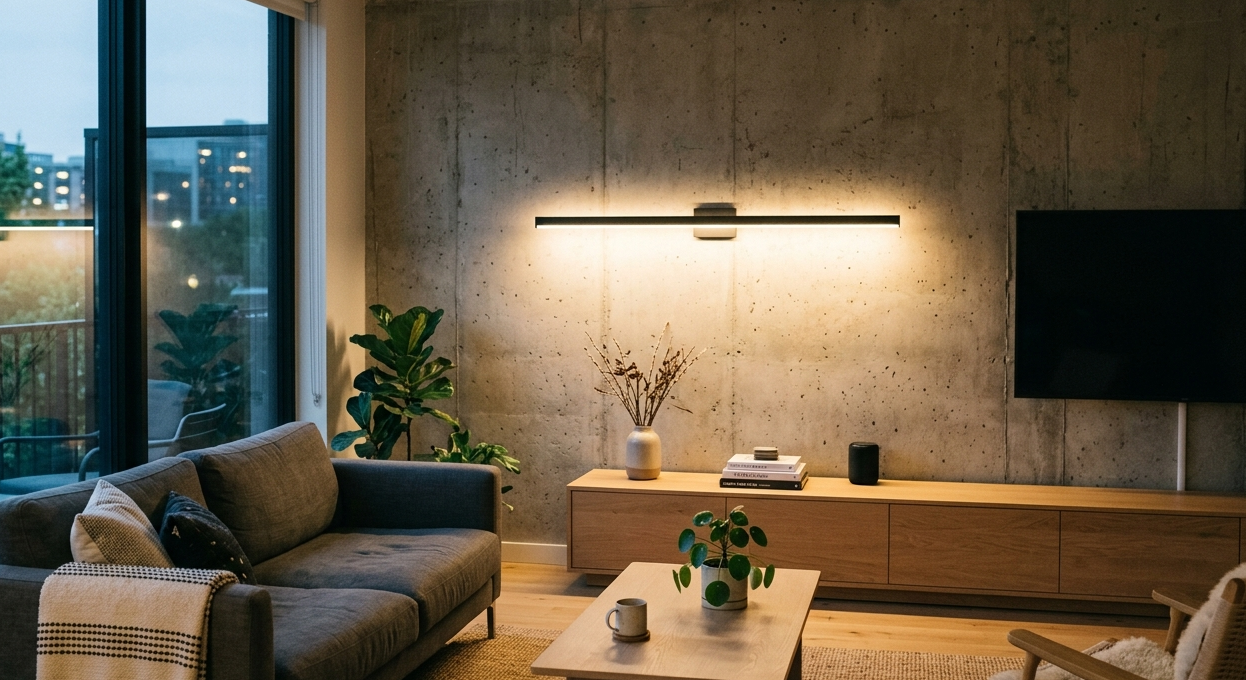



The living room has transitioned from a mere sitting area to a multi-functional sanctuary. As we move through 2026, the “Quiet Luxury” movement has firmly rooted itself in interior design. At the heart of this movement is the minimalist LED wall sconce. No longer just a secondary light source, these fixtures are now architectural statements that define the mood, volume, and sophistication of a modern home.
In this exhaustive guide, we explore why minimalist LED sconces are the definitive lighting choice for 2026, how to select the right materials, and the technical nuances of layering light like a professional interior architect.
1. The Philosophy of Minimalism in 2026 Lighting
Minimalism in 2026 isn’t about “less.” It’s about intentionality. A minimalist LED wall sconce serves a dual purpose: it disappears into the architecture during the day and creates a sculptural shadow play at night.
The Shift from “Fancy” to “Refined”
A few years ago, “fancy lighting” meant crystals and heavy metals. Today, the trend has shifted toward clean lines—slender bars of light, matte finishes, and “invisible” light sources where the bulb is hidden, and only the glow is visible. This shift is driven by the desire for clutter-free environments that reduce mental fatigue.
2. Top Minimalist LED Sconce Trends for 2026
If you are looking to rank your blog or upgrade a client’s home, these are the specific styles dominating the market this year:
A. Linear Architectural Bars
These are ultra-slim vertical or horizontal LED bars that sit flush against the wall. They are perfect for framing a large television or highlighting a piece of art without the distraction of a bulky frame.
- Best for: High-ceiling living rooms and industrial lofts.

B. The “Eclipse” or Circular Glow
Circular sconces that project light backward onto the wall create a halo effect. In 2026, we are seeing these in organic materials like stone, travertine, and brushed brass.
- Why it works: It provides indirect light that is incredibly soft on the eyes, making it ideal for late-night relaxation.

C. Moving Arm Minimalists
Swing-arm lamps have been simplified. The 2026 version features needle-thin arms with tiny, high-output LED heads. They offer functionality for reading while maintaining a “barely there” aesthetic.

3. Technical Specifications: What to Look for
When writing for an audience of homeowners and architects, you must speak the language of quality.
The Importance of CRI (Color Rendering Index)
In 2026, a standard LED isn’t enough. Professional-grade sconces should have a CRI of 90 or higher. This ensures that the colors of your furniture, rugs, and wall paint look vibrant and true to life, rather than washed out or greyish.
Color Temperature (Kelvin)
For living rooms, the “Sweet Spot” is 2700K to 3000K.
- 2700K: Warm, candle-like glow (Perfect for cozy evenings).
- 3000K: Soft White (Ideal for modern, clean aesthetics).
Integrated LED vs. G9/E27 Bulbs
Integrated LEDs allow for the ultra-slim designs we see today. They typically last 25,000 to 50,000 hours. For a minimalist look, Integrated LED is the winner because it removes the need for a bulky bulb housing.
4. Placement Strategy: How to Layer Like a Designer
A common mistake is placing sconces too high or too low. Here is the professional “Rule of Thumb”:
- Eye-Level Alignment: Sconces should generally be mounted 60 to 66 inches (152-167 cm) from the floor.
- The Framing Effect: If placing them on either side of a fireplace or a sofa, ensure they are at least 8 to 12 inches away from the edge of the object they are framing.
- Dimmers are Non-Negotiable: A minimalist sconce without a dimmer is a wasted opportunity. The ability to drop the light to 10% brightness transforms a living room into a private cinema.
5. Material Matters: 2026’s Favorite Finishes
The “look” of 2026 is tactile and matte.
- Matte Black: Still the king of contrast, especially against white or light grey walls.
- Brushed Champagne Gold: A softer, more sophisticated take on traditional brass.
- Concrete & Plaster: Sconces that look like they are part of the wall itself. These can often be painted to match the wall color perfectly.

6. Energy Efficiency and Smart Integration
2026 is the year of the “Invisible Smart Home.” Modern LED sconces now come with built-in Zigbee or Matter-enabled controllers. This means you don’t need a smart bulb; the fixture itself connects to your phone or voice assistant. This allows for “Circadian Lighting”—where the light starts bright and cool in the morning and automatically becomes warm and dim as the sun sets.

7. Maintenance and Longevity
One of the main concerns with “Integrated LED” is: What happens when the light goes out? Professional-grade minimalist sconces are designed with replaceable drivers. Usually, it isn’t the LED that fails, but the driver. High-quality brands now offer modular designs where the driver can be swapped out without removing the fixture from the wall.
8. Conclusion: Why Sconces are the Future of Living Room Design
The chandelier was the center of the 20th-century home. The minimalist wall sconce is the center of the 21st-century home. It represents a move toward personalized, zoned lighting that respects the architecture of the space.
Whether you are a developer in Jaipur or a homeowner in London, investing in high-quality Minimalist LED wall sconces is the fastest way to increase the perceived value of a property in 2026.
Frequently Asked Questions: Expert Insights into 2026 Lighting Trends
1. Are LED wall sconces out of style in 2026?
Quite the opposite. While traditional, bulky sconces have lost favor, minimalist LED wall sconces are at the forefront of the “Quiet Luxury” movement. The focus has shifted from decorative ornaments to “architectural light,” where the fixture enhances the room’s structure rather than cluttering it.
2. What is the ideal height to mount a living room wall sconce?
For most living rooms, the standard mounting height is roughly 60 to 66 inches (about 5 to 5.5 feet) from the floor to the center of the fixture. However, if you have exceptionally high ceilings, you may want to move them slightly higher to maintain visual balance with your furniture.
3. Can minimalist wall sconces replace a central chandelier?
Yes, this is a growing trend known as “Peripheral Lighting.” By using multiple high-output LED sconces, you can illuminate the walls and ceiling, making the room feel larger and more atmospheric than a single, harsh overhead light ever could.
4. What color temperature is best for a modern living room?
For a cozy, residential feel, 2700K (Warm White) is the gold standard. If your living room has a very crisp, white, or industrial aesthetic, 3000K (Soft White) offers a cleaner look without feeling too clinical or “blue.”
5. What does “Integrated LED” mean for wall lamps?
Integrated LED means the light source is built directly into the fixture during manufacturing. This allows for ultra-slim, minimalist designs that wouldn’t be possible with a traditional screw-in bulb. These are designed to last 20+ years under normal residential use.
6. Are gold or brass finishes still trending for 2026?
Yes, but the finish has evolved. The trend has moved away from shiny, polished brass toward “Brushed Champagne Gold” or “Satin Brass.” These matte finishes look more organic and pair beautifully with the minimalist aesthetic.
7. Do I need a professional electrician to install LED sconces?
If you are installing hardwired sconces into a new location, a professional electrician is highly recommended to ensure safety and code compliance. However, many minimalist designs now offer “plug-in” versions with discrete cord covers for a DIY-friendly installation.
8. How do I choose a sconce that won’t cause glare?
Look for “indirect” or “shielded” fixtures. Minimalist sconces that project light back against the wall (like the eclipse or halo style) are perfect for preventing glare while providing plenty of ambient light for the room.
9. Is smart lighting integration worth it for wall sconces?
In 2026, smart integration is a standard expectation. Being able to set “scenes”—such as a dim “Movie Mode” or a bright “Reading Mode”—significantly increases the functionality of your living space and can even improve your sleep-wake cycle through circadian rhythm adjustments.
10. Can I use minimalist indoor sconces for my outdoor gate?
It is not recommended unless the fixture is specifically “IP65 Rated” or higher. Indoor sconces aren’t sealed against moisture and dust. For gate lights, always look for fixtures labeled as “Weatherproof” or “Outdoor Rated” to ensure longevity.
11. How many sconces should I put on a single wall?
Balance is key. For a standard 12-foot wall, a pair of sconces (one on each side of a focal point like a sofa or fireplace) is ideal. For long hallways or larger open-plan spaces, spacing them every 6 to 8 feet creates a sophisticated, rhythmic light pattern.
12. Do minimalist lights work with traditional home decor?
Surprisingly, yes. The “Transitional” design style blends modern fixtures with traditional furniture. A slim, black LED sconce can act as a beautiful “anchor” that brings a touch of modern sophistication to a room with classic wooden furniture.
13. What is the best way to clean matte-finished light fixtures?
Avoid harsh chemicals. A dry microfiber cloth is usually enough for matte black or brass. For concrete or textured plaster sconces, a lightly dampened cloth followed by a dry one will keep the material looking pristine without staining.
14. What is a high CRI and why does it matter?
CRI (Color Rendering Index) measures how accurately a light source reveals the true colors of your decor. You should look for a CRI of 90 or above. This ensures your furniture and wall paint look exactly as they did in the showroom.
15. Are wall sconces energy efficient?
Modern LED wall sconces are incredibly efficient, often using only 8 to 15 watts of power while producing the same amount of light as a 60-watt incandescent bulb. This makes them one of the most eco-friendly ways to light a home in 2026.


Leave a Reply